If you have ever looked at a valve, adapter, faucet connector, or pipe fitting and seen something like “1/2 in. FIP,” the abbreviation can be confusing. It sounds as though it is describing the material the fitting is made from, but that is not really what the label is telling you.
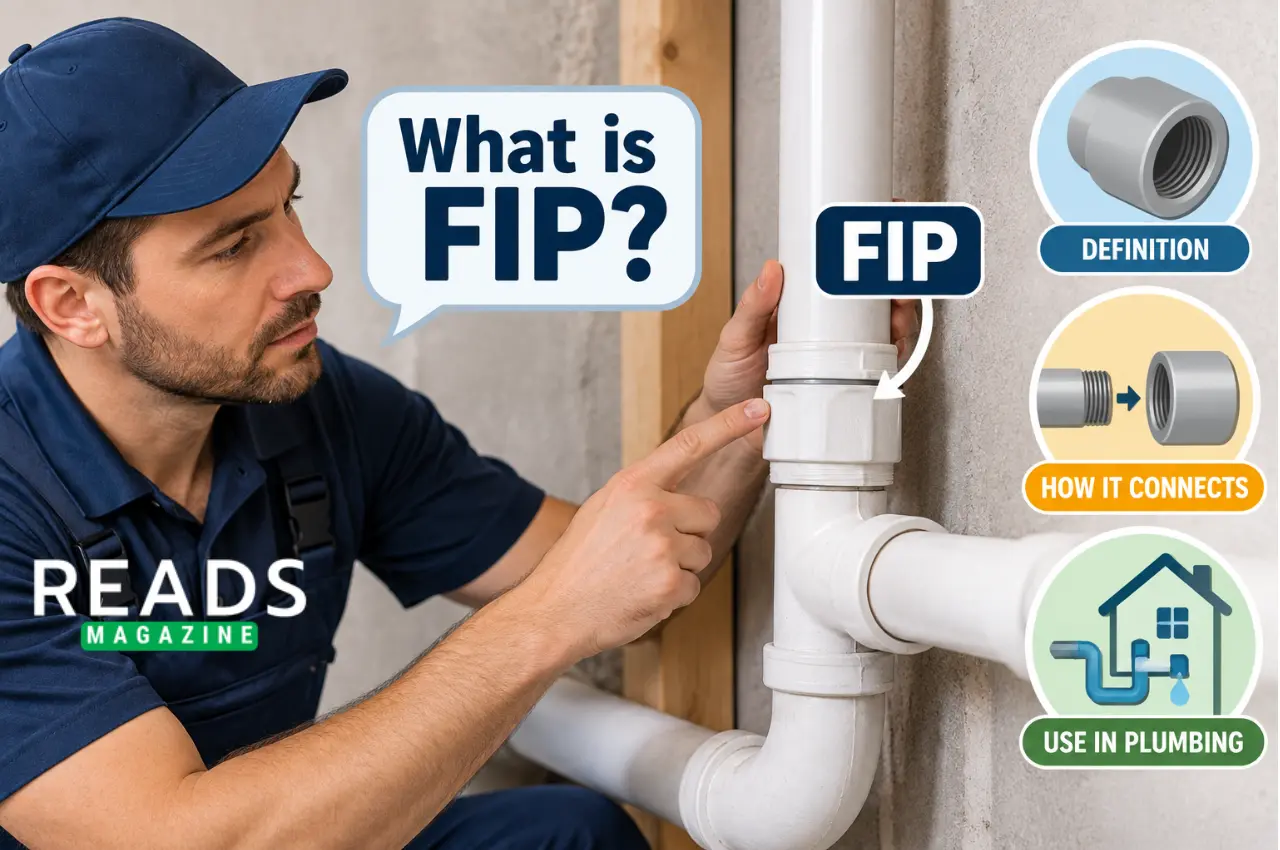
In plumbing, FIP stands for Female Iron Pipe. It describes a threaded connection with the threads located on the inside of the fitting. A matching male-threaded pipe or fitting screws into that opening to create the connection.
Despite the word “iron,” an FIP fitting does not have to be made from iron. FIP connections are commonly found on brass, copper, stainless-steel, PVC, CPVC, and other plumbing components. The term mainly describes the style and size of the threaded connection rather than the material itself.
Understanding FIP becomes much easier once you know how it relates to other abbreviations such as MIP, FPT, NPT, and IPS.
What Does FIP Stand For?
FIP stands for Female Iron Pipe.
The word “female” refers to the location of the threads. Female fittings have their threads cut inside the opening, much like the threads inside a nut. A male fitting has threads on its outside, similar to a bolt.
The “iron pipe” part comes from traditional pipe-sizing and threading terminology. It does not mean that every FIP fitting is made from iron.
So when you see a package marked:
1/2-inch FIP
it generally tells you that the fitting has a female threaded opening designed to accept a compatible 1/2-inch male pipe thread.
What Does an FIP Fitting Look Like?
The easiest way to identify an FIP connection is to look inside the fitting.
If the threads are visible on the inner surface of the opening, it is a female threaded connection. The mating male fitting will have threads around the outside and screws into it.
A simple comparison makes the difference easier to remember:
Connection
Where the Threads Are
What It Connects To
FIP
Inside the fitting
Male threaded fitting
MIP
Outside the fitting
Female threaded fitting
FPT
Inside the fitting
Male pipe thread
MPT
Outside the fitting
Female pipe thread
You can think of an FIP fitting as the nut and an MIP fitting as the bolt.
What Is the Difference Between FIP and MIP?
FIP and MIP describe opposite sides of a threaded plumbing connection.
FIP means Female Iron Pipe, while MIP means Male Iron Pipe. An FIP fitting has internal threads, and an MIP fitting has external threads.
They are designed to connect to each other when the thread size and standard match.
For example, a 3/4-inch FIP valve can normally receive a compatible 3/4-inch MIP pipe nipple or adapter.
FIP vs. MIP at a Glance
Feature
FIP
MIP
Full term
Female Iron Pipe
Male Iron Pipe
Thread location
Inside
Outside
Screws onto
Male fitting
Into female fitting
Common alternative term
FPT or FNPT
MPT or MNPT
Common uses
Valves, couplings, adapters
Nipples, adapters, threaded pipe ends
One of the easiest purchasing mistakes is buying two female fittings or two male fittings and discovering that they cannot screw together.
Is FIP the Same as FPT?
In everyday plumbing use, FIP and FPT are often used to describe the same basic female threaded connection.
FPT stands for Female Pipe Thread. You may also see FNPT, which means Female National Pipe Taper.
Manufacturers, plumbing suppliers, and hardware stores do not always use exactly the same abbreviation on their packaging. One may label a fitting FIP while another describes a very similar connection as FPT.
The important information is that the connection has internal pipe threads and is intended to receive a compatible male threaded fitting.
However, never rely on the word “female” alone. Different plumbing thread standards exist, so both the thread type and size must be compatible.
How Does FIP Relate to NPT?
NPT stands for National Pipe Taper, a widely used threaded pipe standard in North America.
FIP connections commonly use female NPT-style tapered threads. The matching male fitting has corresponding external tapered threads.
The taper means the threads are not perfectly parallel. They gradually change diameter, causing the male and female fittings to fit increasingly tightly as they are screwed together.
This helps create a mechanically secure connection, but threaded plumbing joints typically also require an appropriate thread sealant.
You may therefore see closely related terms such as:
FIP – Female Iron Pipe
FPT – Female Pipe Thread
FNPT – Female National Pipe Taper
MIP – Male Iron Pipe
MPT – Male Pipe Thread
MNPT – Male National Pipe Taper
NPT – National Pipe Taper
For an ordinary homeowner replacing a valve or hose connection, the most important distinction is usually whether the fitting is male or female and whether the nominal sizes match.
Does FIP Mean the Fitting Is Made of Iron?
No. This is probably the most misleading part of the abbreviation.
The word “iron” survives from older plumbing terminology and sizing systems. Today, an FIP connection may be found on many different materials.
Common examples include:
brass
stainless steel
galvanized steel
copper adapters
PVC
CPVC
bronze
A brass valve labeled “3/4 FIP” is still an FIP fitting even though there is no iron in the valve.
When shopping, treat the material and the connection type as separate specifications. You may need a brass fitting with an FIP connection, a PVC adapter with an FIP connection, or another combination suited to your plumbing system.
What Does 1/2-Inch FIP Mean?
A label such as 1/2-inch FIP indicates the nominal pipe-thread size of the female connection.
This can be confusing because pipe sizes are nominal rather than simple measurements of the opening with a ruler. A 1/2-inch pipe thread does not necessarily measure exactly half an inch across its outside diameter.
That is why visually estimating the size of a threaded fitting can lead to the wrong purchase.
If you are replacing an existing fitting, bringing the old part to the hardware store is often the simplest option. You can also identify the nominal pipe size using the correct measurements and a pipe-thread reference chart.
Common residential FIP sizes include:
FIP Size
Common Applications
1/4 inch
Small valves, gauges, appliance connections
3/8 inch
Supply and fixture connections
1/2 inch
Faucets, shower fittings, valves
3/4 inch
Water heaters, larger valves, supply piping
1 inch
Larger residential or commercial water piping
The actual application can vary widely, so size alone does not tell you what the fitting is intended for.
Where Are FIP Fittings Used?
Female threaded pipe connections appear throughout residential and commercial plumbing because they provide a convenient way to connect threaded components.
You may encounter FIP connections on:
shutoff valves
water heaters
pressure regulators
pumps
shower arms and fittings
irrigation components
pipe couplings
threaded adapters
appliance connections
faucets and plumbing fixtures
some gas-line fittings
hose and supply-line adapters
For example, a water heater may have threaded connections that connect to adapters or flexible supply lines. A shutoff valve may have an FIP inlet that screws onto a male threaded pipe.
The exact fitting depends on the plumbing material and system design.
What Is an FIP Adapter?
An FIP adapter converts another type of plumbing connection into a female threaded pipe connection.
For instance, one end of an adapter may connect to copper, PVC, CPVC, or PEX plumbing while the other end provides a female pipe thread.
Examples include:
PVC slip x FIP adapter
CPVC socket x FIP adapter
copper sweat x FIP adapter
PEX x FIP adapter
These adapters are useful when two sections of a plumbing system use different connection methods.
A PVC pipe, for example, may use a glued socket connection for most of its run but need to connect to a threaded metal valve. An adapter provides the transition between the two.
FIP vs. Compression Fittings
A compression connection is not the same as an FIP connection, even though both may appear on plumbing valves and supply lines.
Compression fittings create a seal using a compression nut and ferrule rather than tapered pipe threads. The sealing mechanism is therefore different.
FIP Connection
Compression Connection
Uses pipe threads
Uses nut and ferrule
Usually requires thread sealant when appropriate
Ferrule creates the seal
Connects to matching male pipe thread
Connects to correctly sized tubing
Identified by pipe-thread size
Identified by tubing size
This difference matters when replacing shutoff valves beneath sinks or toilets, where several connection styles can look similar at first glance.
A 1/2-inch FIP fitting and a 1/2-inch compression fitting should not be treated as interchangeable simply because both descriptions contain the same number.
FIP vs. Flare Connections
Flare fittings also differ from FIP threads.
With a flare connection, the end of tubing is shaped into a flared surface. The seal occurs where that flare contacts the mating fitting rather than on the threads themselves.
This is why adding pipe-thread tape to every threaded-looking connection is not good practice. Some threads simply provide clamping force while the actual seal is created somewhere else.
Understanding the connection type before applying sealant is important.
Do FIP Connections Need Thread Tape?
Many tapered pipe-thread connections require an appropriate thread sealant to help prevent leakage. PTFE thread-seal tape, commonly called plumber’s tape or Teflon tape, is frequently used on suitable male pipe threads.
Pipe-thread sealant, sometimes called pipe dope, is another common option.
However, the correct sealing method depends on the material, the fluid or gas being carried, manufacturer instructions, and local plumbing requirements.
Thread tape should normally be applied to the male threads rather than stuffed into the female fitting. When applied correctly, it should follow the direction in which the fitting will be tightened so the tape does not unravel during assembly.
Not every threaded plumbing connection should receive PTFE tape. Compression fittings, flare fittings, and connections that seal with washers or gaskets may require different treatment.
How Tight Should an FIP Connection Be?
Threaded fittings need to be tight enough to create a secure seal, but overtightening can cause problems.
With metal fittings, excessive force can damage threads or crack certain valves and fittings. With plastic female-threaded fittings, overtightening can be particularly risky because the expanding force of a tapered male fitting can split the female fitting.
The correct approach usually involves threading the fitting by hand first to make sure the threads are properly aligned, then tightening further with suitable tools according to the fitting manufacturer’s guidance.
If the connection requires extreme force from the beginning, stop. Cross-threaded or incompatible fittings can become damaged very quickly.
What Is Cross-Threading?
Cross-threading happens when male and female threads engage incorrectly.
Instead of following the existing spiral thread path, the fitting starts cutting or forcing its way across the threads. The connection may become extremely difficult to turn and can permanently damage one or both components.
Common warning signs include:
fitting becomes tight almost immediately
connection sits at an angle
threads feel rough or jerky
fitting will not screw in several turns by hand
metal or plastic shavings appear around the threads
A compatible pipe-thread connection should generally begin threading relatively smoothly by hand.
Forcing a fitting with a wrench from the first turn can turn a minor alignment problem into a ruined valve or adapter.
Can FIP Connect Directly to MIP?
Yes, assuming the FIP and MIP fittings use compatible thread standards and nominal sizes.
A 1/2-inch FIP fitting is designed to accept a compatible 1/2-inch MIP connection. A 3/4-inch FIP fitting similarly connects to a corresponding 3/4-inch male pipe thread.
However, matching nominal size does not always guarantee compatibility if the thread standards differ.
For example, NPT and certain straight-thread or foreign pipe-thread standards can look similar but are not necessarily interchangeable. Trying to force incompatible threads together can damage the fitting or create a leaking connection.
Why Doesn’t My FIP Fitting Fit?
If two fittings look approximately the right size but will not screw together properly, several problems are possible.
The Gender Is Wrong
Two female fittings cannot directly thread into each other. You may need a male nipple or adapter between them.
The Nominal Sizes Are Different
A fitting that appears close in diameter may actually be a different nominal pipe size.
The Thread Standards Are Different
NPT, BSP, flare, compression, and straight-thread connections are not automatically compatible.
The Threads Are Damaged
Old fittings can become corroded, crushed, or cross-threaded.
Debris or Old Sealant Is Blocking the Threads
Old thread compound, corrosion, or damaged PTFE tape can prevent smooth assembly.
If a threaded joint does not start correctly by hand, identifying the cause is safer than applying more force.
What Is IPS in Plumbing?
IPS stands for Iron Pipe Size.
It is another term you may encounter when shopping for plumbing fittings and pipes. Like FIP, the name reflects historic iron-pipe sizing even though modern plumbing materials can include plastic and other metals.
IPS describes a pipe-sizing system rather than specifically telling you whether the fitting has internal or external threads.
That means “IPS” and “FIP” are related plumbing terminology, but they do not mean exactly the same thing.
Common Plumbing Thread Abbreviations
Hardware-store shelves can contain a surprising number of similar abbreviations. Knowing a few of them makes choosing the correct fitting much easier.
Abbreviation
Meaning
FIP
Female Iron Pipe
MIP
Male Iron Pipe
FPT
Female Pipe Thread
MPT
Male Pipe Thread
FNPT
Female National Pipe Taper
MNPT
Male National Pipe Taper
NPT
National Pipe Taper
IPS
Iron Pipe Size
You may also encounter abbreviations for completely different connection methods, including compression, flare, socket, slip, sweat, push-fit, and barbed connections.
Always identify the full connection type rather than matching only the diameter.
How to Buy the Right FIP Fitting
The easiest way to avoid repeated trips to the plumbing aisle is to identify several things before purchasing a replacement part.
First, determine whether you need a male or female connection. Then identify the nominal pipe size and the type of thread or connection on the other side of the fitting.
It is also worth checking:
The fitting material.
Pipe material it will connect to.
Intended use, such as potable water, irrigation, or gas.
Pressure and temperature requirements.
Whether the connection needs a specific sealant.
Whether local plumbing codes impose additional requirements.
Taking a clear photograph of the existing installation and bringing the old fitting with you can make matching parts considerably easier.
Can You Use Brass MIP With Plastic FIP?
Metal male threads can sometimes connect to plastic female threaded fittings, but this combination requires care.
A tapered metal male fitting is much stronger than a plastic female fitting. Overtightening can create outward pressure that cracks the plastic fitting, sometimes immediately and sometimes later.
Compatibility also depends on the specific plastic, application, temperature, and manufacturer requirements.
When working with PVC, CPVC, or other plastics, follow the fitting manufacturer’s instructions rather than assuming the same tightening technique used for two brass fittings is appropriate.
Is FIP Used for Gas Lines?
FIP-style threaded connections can appear in gas piping systems, but gas work carries additional safety and code requirements.
A fitting that physically screws together is not automatically approved for fuel-gas service. The material, fitting rating, sealant, installation method, and local code requirements all matter.
If you are dealing with natural gas or propane and are unsure about the connection type, using a qualified professional is considerably safer than experimenting with fittings until one appears to fit.
A small water leak is inconvenient. A gas leak can create a fire, explosion, or carbon monoxide hazard.
FIP Questions Answered Quickly
Question
Answer
What does FIP mean in plumbing?
Female Iron Pipe
Where are the threads on an FIP fitting?
Inside the fitting
What connects to FIP?
A compatible male threaded fitting, commonly called MIP
Is FIP made from iron?
Not necessarily; FIP describes the connection style
Is FIP the same as FPT?
The terms are often used interchangeably for female pipe threads
Is FIP usually NPT?
In North American plumbing, FIP commonly refers to a female NPT-style connection
Does 1/2-inch FIP measure exactly half an inch?
No; pipe-thread sizes are nominal
Does FIP need thread tape?
Many tapered pipe-thread joints need suitable sealant, but not every threaded connection uses tape
Can FIP connect to compression fittings?
Not directly unless an appropriate adapter is used
Can FIP connect to MIP?
Yes, when the size and thread standard match
The Simple Way to Remember It
FIP sounds technical, but the concept is straightforward once you ignore the historical wording.
The “F” is the important part: Female Iron Pipe means the threads are inside the fitting. A matching male pipe thread screws into that opening. The “iron pipe” wording describes traditional pipe-thread terminology and does not mean the fitting itself must be made from iron.
When buying plumbing parts, however, identifying a fitting as FIP is only the first step. You still need the correct nominal size, compatible thread standard, suitable material, and proper sealing method.
If you remember just one thing at the hardware store, make it this: FIP has threads inside, MIP has threads outside, and matching those two correctly can save you both a second shopping trip and a leaking plumbing connection.
















Comments are off for this post.