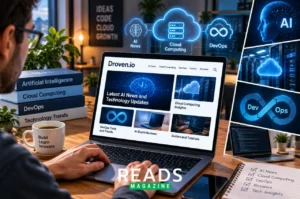
Droven.io is an active technology publication covering artificial intelligence, automation, cloud computing, cybersecurity, software development, digital transformation and other areas of modern tech. It is best understood as an editorial website where readers browse articles, guides and reviews, not as an AI tool or software platform they log into and use.
That distinction matters because search results around the name can be confusing. Phrases such as “Droven.io AI automation tools,” “Droven.io IT services in USA” and “Droven.io AI technology” can make the site sound like a software vendor or consulting company. The live website in October 2026 points much more clearly toward a content-first model, with category pages, reviews, explainers and regularly published articles rather than a customer dashboard or service catalogue.
Droven.io in Simple Terms
Detail
Information
Website
Droven.io
Main purpose
Technology publishing and education
Current status
Active in 2026
Main subjects
AI, cloud, cybersecurity, software, DevOps and digital transformation
AI news coverage
Yes
AI tool reviews
Yes
Cloud computing guides
Yes
DevOps-related content
Yes
Technology reviews
Yes
Own AI software platform
Not clearly offered
Customer dashboard
Not found as a central feature
Paid SaaS plans
Not clearly offered
IT services company
Not established
General contact
Email-based editorial contact
Best use
Learning, discovery and early-stage research
The website currently describes itself as an editorial source for AI, technology and digital transformation. Its navigation and publishing pattern support that description much more strongly than claims that Droven.io is a standalone automation product.
What the Droven.io Website Actually Publishes
The live site is organized into several broad content areas rather than one continuous news feed. AI has its own set of sections covering artificial intelligence, generative AI, AI tools, AI in business and marketing, and automation-related work. Technology sections include cybersecurity, software development, web development, future technology and broader IT topics.
Droven.io also publishes material on digital transformation, big data and analytics, productivity tools, tech reviews and the future of work. That mix gives the site a fairly wide scope while still keeping most of its content within technology and business use cases.
Recent 2026 articles show that the publication is being updated regularly rather than operating as an abandoned domain filled with older posts.
The AI News Portal Description Makes Sense
Calling Droven.io an AI news portal is reasonable as long as the word “portal” is understood correctly.
The site does not function like a live newswire that reports every model release or company announcement within minutes. Much of its AI coverage is explanatory, with articles designed to help readers understand technologies, tools, trends and business applications.
That can include subjects such as agentic AI, AI-generated video, AI leadership training, chatbots, generative models and business automation. Some pieces are closer to guides or comparisons than conventional breaking news.
So the term “AI news portal” works best as a broad description of its subject area rather than a promise of minute-by-minute news reporting.
Droven.io AI Technology Means Coverage, Not a Product
One source of confusion comes from the phrase Droven.io AI technology.
The site writes extensively about artificial intelligence, but that does not mean Droven.io has created its own AI model, chatbot or machine-learning platform. There is no clearly promoted proprietary model, API or AI workspace on the public site.
When an article discusses AI agents, automation software or generative AI, the subject is usually the technology itself or a third-party tool.
That difference is important because readers can easily mistake editorial coverage for product ownership. A publication explaining an AI platform is not automatically the developer of that platform.
AI Automation Tools Are Discussed, Not Supplied
The same principle applies to Droven io AI automation tools.
Droven.io publishes content around automation and AI-assisted business processes, including articles about tools, workflows and operational use cases. That can make the site useful for discovering software that may help with marketing, content, analytics or other work.
What it does not appear to provide is its own automation builder where users create workflows directly.
There is no obvious central dashboard comparable with services built specifically for workflow automation. Readers interested in a tool discussed on Droven.io normally need to visit the actual software provider for pricing, account creation, setup and technical support.
The Cloud Computing Section Is a Learning Resource
The Droven.io cloud computing guide section sits within the site’s wider technology coverage.
Cloud computing articles can help readers understand areas such as infrastructure, deployment, hosting, cloud services and how businesses use remote computing resources. These topics overlap naturally with software development, cybersecurity and DevOps, so the sections often connect with one another.
The site works best here as an introductory or intermediate reading resource. Someone unfamiliar with a cloud concept can get enough context to understand the basic idea before moving to AWS, Microsoft Azure, Google Cloud or another provider’s documentation.
For an actual production deployment, the official provider documentation should still be the technical authority.
DevOps Tutorials Need the Same Distinction
Searches for Droven.io DevOps tutorials can create expectations of detailed command-by-command technical training.
The site does cover DevOps-related ideas, including software deployment, automation, infrastructure, monitoring and modern development practices. Some articles can function as practical explainers, but the overall publication is not structured like a full developer documentation portal.
That means the depth will vary.
An article explaining Docker, Kubernetes or CI/CD may be useful for understanding what a tool does and why teams use it. It should not automatically replace the official documentation when someone needs exact commands, version-specific configuration or security-sensitive instructions.
Software Development Is Another Major Topic
Software development coverage sits alongside AI and cloud material.
The site includes articles about web development, applications, digital tools and the technologies businesses use to build or modernize systems. Some topics are highly technical, while others are written for managers or general readers who need enough knowledge to make a business decision.
That mixed audience explains why not every article reads like developer documentation.
Droven.io appears to aim for accessibility rather than assuming every reader is already an engineer. For beginners, that can be useful. More experienced developers may need deeper sources once they move from understanding a topic to implementing it.
Cybersecurity Content Should Be Used Carefully
Cybersecurity is another visible part of the technology section.
Articles can introduce readers to privacy, digital threats, AI-assisted attacks and security tools. These subjects are useful for awareness, but they can also change quickly as vulnerabilities, products and recommended practices evolve.
For general learning, a technology blog can be a helpful starting point. For a live security incident, compliance requirement or production configuration, readers should go directly to official vendor documentation, recognized standards or qualified security professionals.
This is not unique to Droven.io. It is a sensible way to use any general technology publication.
Reviews Are About Third-Party Products
Droven.io has dedicated areas for technology reviews, AI tool reviews and productivity tools.
That makes Droven.io reviews one of the more natural ways people encounter the site. The subjects can range from AI products and software services to hardware and digital platforms.
A review should be separated from official product information. If Droven.io compares two tools or explains a service, the manufacturer or developer remains the source for exact pricing, compatibility, terms and technical specifications.
Readers should also check article dates because AI software can change features and subscription tiers several times within a year.
Digital Transformation Broadens the Site Considerably
Not every Droven.io article is narrowly technical.
The Digital Transformation category includes content about how businesses use technology to change marketing, operations, education, manufacturing and other everyday processes. Some articles can therefore look closer to business advice than traditional IT journalism.
This broader approach explains why occasional subjects may seem only loosely connected with AI.
Digital transformation is a wide term, and publishers often use it for topics ranging from automation and analytics to digital displays, business software and operational tools.
For Droven.io, this category acts as a bridge between pure technology coverage and practical business use.
Big Data and Analytics Get Their Own Space
Data is another recurring subject on the website.
The Big Data & Analytics section covers ways businesses collect, understand and use information. Topics can include marketing analytics, competitive intelligence, decision-making and software that helps organizations work with larger amounts of data.
This material will be most useful to readers trying to understand why a tool or method matters.
As with other technical subjects, the site should not be mistaken for the actual analytics platform being discussed. A guide can explain how a product category works without providing the software itself.
Future of Work Adds a Career Angle
Droven.io also publishes material around emerging technology careers and workplace change.
This includes roles connected with AI, data, cloud technology and other areas affected by automation. The content can help students, career changers and existing IT professionals understand which skills appear in newer job categories.
Job titles in technology are not standardized across every employer, so readers should avoid treating one article’s definition as universal.
Actual job listings remain useful for seeing which skills companies are currently requesting in a specific market.
Is Droven.io an IT Services Company in the USA?
The available website does not strongly support describing Droven.io as a US IT-services provider.
There is no prominent service catalogue offering software development, managed IT, cloud migration, cybersecurity consulting or similar client services. There is also no obvious quote-request system or package structure showing that companies hire Droven.io to perform technical work.
The site’s content frequently discusses American businesses, careers and technology trends, which likely explains why searches such as droven.io IT services in USA appear.
That audience focus should not be confused with actually providing IT services.
There Is No Obvious SaaS Dashboard
Software companies normally make the product easy to identify.
They often have buttons such as Sign Up, Start Free Trial, View Pricing, API Documentation or Log In. Users can see what the application does and how to begin using it.
Droven.io’s public experience is different. The main navigation leads toward article categories, reviews and editorial content.
That provides another practical clue that the website is a publication rather than SaaS.
Someone searching for a Droven.io login or automation dashboard may therefore be looking for something the current site does not offer.
Is Droven.io Free?
The articles reviewed on the live website can currently be read without a standard subscription paywall.
There is no central pricing page selling access to a premium AI platform, and normal browsing does not appear to depend on creating a customer account.
That does not mean every product mentioned by the site is free.
An AI application, cloud platform or productivity tool discussed in an article may have its own free tier, paid subscription or enterprise pricing. Readers should check the provider rather than assuming Droven.io’s free editorial access applies to third-party software.
Who Runs Droven.io?
Public information about the people behind the site is limited.
The website provides an editorial contact address and identifies itself as a technology publication, but a clearly presented founder, leadership team and detailed company history are not prominent on the public pages.
That does not prevent the site from functioning normally as a publication.
It does mean readers should be careful with confident third-party claims about ownership, funding or corporate structure unless they are supported by stronger records.
There is little value in inventing a startup story where the website itself does not provide one.
The Site Is Clearly Active in 2026
Freshness is one area that can be checked directly.
The homepage contains articles published in late September and early October 2026, including new material on AI courses, AI video creation and other current technology subjects.
That confirms Droven.io is actively publishing at the time of writing.
For readers, this matters because older technology blogs can continue ranking long after they stop receiving updates. A live publishing schedule gives Droven.io a better chance of reflecting current terminology and products, although individual facts should still be checked when they change quickly.
Is Droven.io Legit?
Droven.io is a functioning technology website with current articles, organized categories, contact information and standard policy pages.
That supports describing it as a real editorial site rather than a fictional AI product.
“Legit,” however, can mean several different things. The existence of a real publication does not guarantee that every review, technical explanation or recommendation is perfectly accurate.
The sensible approach is to use Droven.io for discovery and background reading, then confirm important technical, security, pricing or business details with the original source.
How Useful Are Droven.io Reviews?
The review section can be helpful when someone wants an initial impression of unfamiliar software or technology.
A good review can explain what the product is designed to do, which users it suits and where it differs from alternatives. That saves time before visiting several vendor websites.
The limitation is freshness.
AI and SaaS companies frequently change features, prices, limits and even product names. A review written a few months earlier may already contain details that have changed.
For purchase decisions, always compare the review date with current information from the vendor.
Beginners May Get More Value Than Advanced Engineers
Droven.io’s style tends to work best when a reader is still learning the shape of a subject.
Someone who has heard terms such as agentic AI, cloud infrastructure, digital transformation or AI automation can use an explainer to understand the basic idea without immediately facing dense technical documentation.
Advanced engineers will often need more.
When the question becomes how to configure a Kubernetes cluster, secure a production API or build a specific cloud architecture, first-party technical documentation and specialized engineering resources become more appropriate.
That does not make an introductory article weak. It simply defines what the article is for.
Watch for Similar-Looking Droven Domains
Droven.io is not the only domain on the web using the word Droven or a close variation.
Search results can surface sites with similar names, different domain endings or additional words. Those should not automatically be treated as official mirrors or sister sites.
Before trusting contact details, downloads or account forms, check the exact domain.
A site named Droven something is not necessarily operated by the same people as Droven.io.
This becomes particularly important if another site asks for payment, software installation or sensitive account information.
How to Use the Site Without Over-Relying on It
The most productive way to use Droven.io is as the first or second step in research rather than the last.
Start with an article to understand the terminology and identify relevant products, technologies or concepts. Then move to original documentation, company pages, technical standards or independent specialist sources when the decision becomes more important.
This approach is especially useful for AI because the field changes so quickly.
An article can help you understand what an AI agent does, but the documentation of the specific agent platform should tell you what features are available today.
Frequently Asked Questions About Droven.io
What is Droven.io?
Droven.io is a technology publication covering artificial intelligence, software, cloud computing, cybersecurity, digital transformation, reviews and related tech subjects.
Is Droven.io an AI news portal?
Yes, that is a reasonable description of part of the site. It publishes AI news, explainers, tool coverage and business-focused AI content.
Is Droven.io an AI tool?
No clear evidence shows that Droven.io itself operates as an AI software tool. Its main public function is publishing technology content.
Does Droven.io offer AI automation tools?
It publishes articles about AI automation and third-party tools, but there is no clearly established Droven.io automation platform or workflow builder.
What does the Droven.io cloud computing guide cover?
The site’s cloud section covers cloud and infrastructure topics as part of its wider technology content. It is better suited to learning and research than as a replacement for vendor documentation.
Does Droven.io publish DevOps tutorials?
It covers DevOps concepts and related technologies, although the depth varies by article. Advanced technical work should still be checked against official documentation.
Is Droven.io a technology blog?
Yes. “Technology blog,” “editorial technology site” and “tech publication” all describe its current public format reasonably well.
Does Droven.io provide IT services in the USA?
There is no clear public evidence of a dedicated IT-services business with consulting packages, managed services or client-facing technical service plans.
Is Droven.io free to use?
Its public editorial content is currently available to read without a standard paid subscription.
Does Droven.io have a login?
A customer login or SaaS dashboard is not a central feature of the current public site.
Is Droven.io safe?
It operates as a normal public technology website. Readers should still evaluate third-party links and confirm important technical or financial information before acting on it.
Who owns Droven.io?
The site’s public pages do not prominently identify a confirmed founder or detailed ownership structure.
Is Droven.io active in 2026?
Yes. New articles were still being published in October 2026.
Droven.io: A Tech Publication, Not an Automation Tool
Droven.io makes much more sense once its editorial role is separated from the technologies it writes about. The site covers AI tools, cloud computing, DevOps, cybersecurity, digital transformation and software, but publishing an article about those technologies does not mean Droven.io provides them as its own products.
Its main strength is accessibility. Readers can use the site to understand an unfamiliar technology, discover tools and follow current AI or business-tech topics before moving into more specialized material. The active 2026 publishing schedule also means it is not simply an old domain surviving through archived content.
The main limitation is the same one that applies to many broad technology publications: important details need another level of verification. Use Droven.io to understand the subject and identify what deserves a closer look, then rely on first-party documentation when you are ready to install, buy, configure or make a serious business decision.



















Comments are off for this post.